

.jpg)


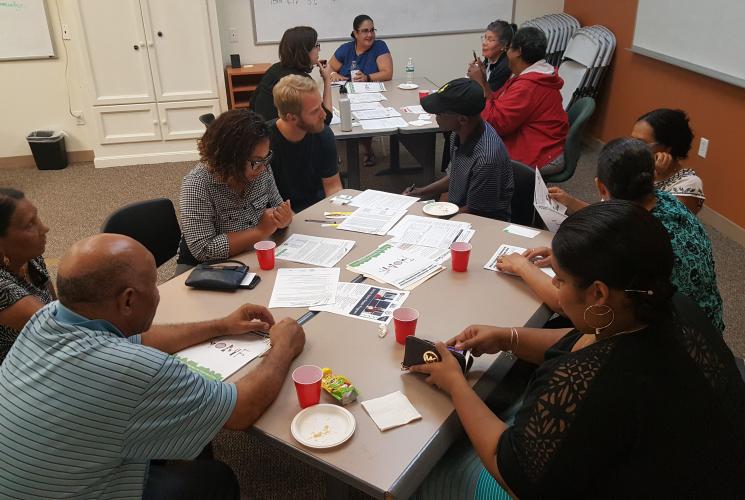

According to intergroup contact theory, prejudice thrives in the absence of meaningful interaction between members of different social groups. Although originally applied in the context of race, a growing body of research has generalized the theory to a variety of intergroup relations. For example, Lee et al. (2004) found that exposure to homelessness as simple as reading about it or discussing it with friends effectively "encourages the development of positive emotions and empathy" towards "homeless people as a whole." By creating a platform for intimate and authentic cross-class contact, Insight Exchange lays the groundwork for prejudice reduction.
+

Media richness theory posits that information communicated through “lean” mediums with less sensory modality (e.g., email) is more susceptible to loss or misinterpretation than information communicated through “rich” mediums with greater sensory modality (e.g., video). By harnessing the power of face-to-face interaction, the richest medium of communication, Insight Exchange forces audiences to confront the humanity of speakers in ways that cannot be done through news articles or social media posts.
+

Finally, the concept of impressionability describes the “critical periods” during which lifelong attitudes and behaviors are established, namely, adolescence and young adulthood. To change these attitudes and behaviors, Gwon and Jeong (2018) note, participation in activities, including “[e]ducational programs and new lessons,” and interpersonal factors, including “[o]bservation and interaction with others,” are necessary. By targeting the teenage demographic with engagements at schools and universities, Insight Exchange prevents bias from crystalizing in the minds of the young.
=
        %%{init: { 'theme': 'base', 'themeVariables': { 'fontFamily': 'Open Sans', 'fontSize': '1rem' } } }%%
    graph TD
        %% Main Node
        Net[Insight Exchange financials]

        %% Level 1: The Split
        Net --- Rev[Revenue streams]
        Net --- Cost[Cost structure]

        %% Level 2: Revenue Breakdown
        Rev --- Fees[Speaking fees]
        Rev --- Phil[Philanthropy]

        %% Level 3: Revenue Levers
        Fees --- Edu["Educational institutions
($500–$1,500)"]
        Fees --- Corp["Corporations
($1,500–$10,000)"]

        Phil --- Grants[Grants]
        Phil --- Don[Individual donations]

        %% Level 2: Cost Breakdown
        Cost --- Var[Variable costs]
        Cost --- Fix[Fixed costs]

        %% Level 3: Cost Levers
        Var --- Spk[Speaker payments]
        Var --- Log[Logistics]

        Fix --- Mkt[Marketing]
        Fix --- Vol[Training]

        %% Colors / CSS Styling within Mermaid
        classDef main fill:#333333B3,stroke:#000000,stroke-width:1px,color:#fff;
        classDef revenue fill:#d4eddaB3,stroke:#28a745,stroke-width:1px,color:#155724;
        classDef cost fill:#f8d7daB3,stroke:#dc3545,stroke-width:1px,color:#721c24;
        classDef savings fill:#d1ecf1,stroke:#17a2b8,stroke-width:1px,color:#0c5460;

        class Net main;
        class Rev,Fees,Phil,Edu,Corp,Grants,Don revenue;
        class Cost,Var,Fix,Spk,Log,Mkt cost;
        class Vol savings;